|
||
|
Entry 008 — Technology 87% covered, 27% onlineSub-Saharan Africa end-2023 mobile internet coverage, use, and usage gap |
||
|
||
|
Source: GSMA, The State of Mobile Internet Connectivity Report 2024; GSMA, Sub-Saharan Africa 2024 Year in Review |
||
|
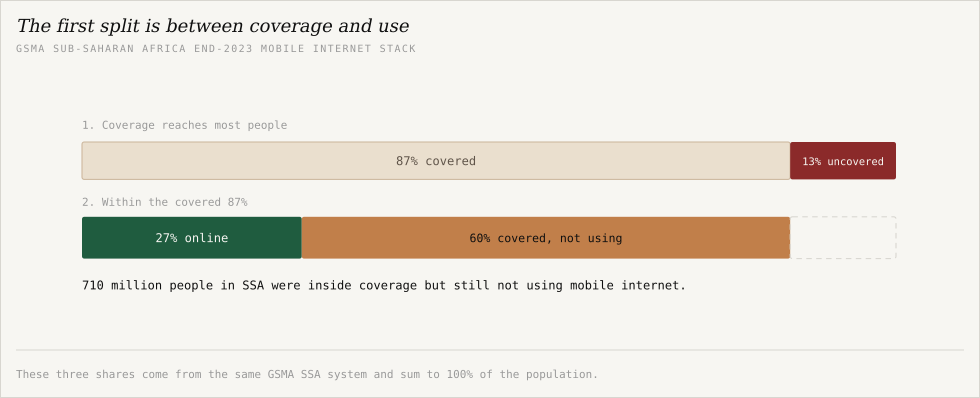
Most discussion of internet access in sub-Saharan Africa still starts with coverage. But end-2023 GSMA estimates suggest the larger problem now sits inside the network footprint itself: 87% of the population is covered by mobile broadband, yet only 27% uses mobile internet. That leaves a 60% usage gap, or roughly 710 million people who live inside coverage but still remain offline. This piece asks three questions. Where is internet use still low even when signal is already present? How far does mobile data pricing explain the gap? And what barriers still fit the evidence once coverage is no longer the main constraint? The short answer is that cheap data helps, but it does not settle the story. Nigeria and Ghana pay almost the same price for 1GB, yet their internet-use rates are far apart. Across the evidence, recurring affordability pressure and persistent rural and gender divides fit the gap more directly than a simple coverage story. |
||
| Read Entry 008 → | ||
|
Until next time, Theophilus Editor, Open Ordinal |
||